A single tooth of the megalodon or the giant shark of prehistoric times is no more than nature’s foolproof record of what the ocean back then had. The colossal teeth are responsible for revealing prehistoric climate trends, changes in marine life, and the presence of the enormous shark and subsequent developments on Earth. Although for the collectors it is a chance to own a piece of history, eons of time in their palm, and that too in a very lucid form, each tooth gives.
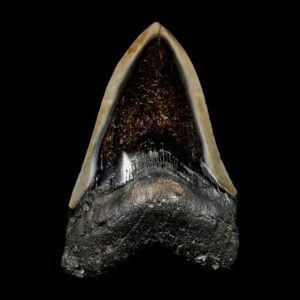
But what exactly makes these fossils so powerful that we can see through Earth’s past with them? The reply rests in their materials, their toughness, and the astonishing wanderings they undertake prior to ending up in the hands of the present-day hobbyists.
What Secrets Do Megalodon Teeth Preserve?
The mineral signatures in the megalodon fossil tooth record the chemistry of ancient seawater. The organic material is replaced by minerals such as phosphate and iron over millions of years, enabling one to determine the temperature, salinity, and sediment history—locking in all those details. It is due to this very process that these teeth can last for quite a long time, even after all the soft-bodied animals have disappeared. The structures of these teeth are such that they become geological diaries and carry clues to not only the habitats that the megalodons ruled but also the environmental pressures that contributed to their evolution.
These fossils are packed with patterns of wear, feeding marks, and growth lines. The serrations each tell a part of the story—the shark’s hunting method, prey choice, and even feeding frequency. The physical facts emerge as a very dependable tool for recreating the oceanic ecosystem of the past that no longer exists.
How Do Fossil Layers Reveal Ancient Oceans?
When the fossil of a megalodon tooth is found, it is not usually just at the surface. Most fossils are removed from rivers, offshore deposits, fossil-rich cliffs, and submerged sediments. The different layers in which the fossils are found reveal:
- The depth and temperature of the ancient oceans
- The times when the sea level rose or fell
- The geological activities that buried or exposed ancient coastlines
- The migration patterns of the enormous marine predators
Every layer behaves like a time stamp, helping the researchers link the fossils to certain eras. That is why every tooth is not only of value for its size or color, but also for the embedded geological story, basically.
Why Do Megalodon Teeth Survive So Well?
Contrary to bones, shark teeth are very much mineralized and are replaced during a shark’s life. Megalodons produced tens of thousands of teeth, and their compactness made them incredibly tough. When they dropped into the ocean floor, they did not rot but took in minerals that made them even stronger. Pressures and geological activity turned them into the most robust marine fossils still being excavated.
It is this very quality that makes them plentiful today. Distinctive features are the collectors’ main reason for their acquisition, not just their aesthetics, but the fact that they have survived so well from the past—often coming out of sediments with very slight damage still showing sharp edges or smooth enamel.
How Does Modern Collecting Connect Us to Prehistoric Seas?
Collectors often say that the experience of holding a megalodon tooth fossil is like touching the ancient world. These fossils connect the periods of human history and a time when there were no humans on Earth. Just one tooth can trigger curiosity, inspire scientific learning, or become a significant piece of a collection.
The very act of obtaining one, however, is part of the whole experience. Fossil lovers around the globe are committed to finding genuine specimens, and credible sellers are committed to ethical, legal, and environmentally responsible sourcing. The tooth is millions of years old, so the journey that it takes from the seabed to the display shelf by way of being sediment adds value to the story that no manufactured item can mimic.
Are Megalodon Teeth Still Changing Scientific Research?
The answer is yes, much to the surprise of many. The new studies have made it possible for scientists to ascertain migration paths, worldwide sea temperatures, and relationships among species based solely on teeth. Modern technology also reveals isotopic distributions that allow for very precise climate reconstructions. Every new finding convinces the scientists even more that megalodon tooth fossils have, and will always be, one of the main instruments for the study of ancient oceans.
Conclusion: Where Can You Explore Authentic Megalodon Fossils?
You could either get a wonderful megalodon shark tooth as a present or, better yet, feel the weight of deep time yourself. Fossil Age Minerals is a great place to start your hunt, as the company has an outstanding collection that is good for both casual users and serious collectors due to its reputable sourcing, ethical gathering, and extensive.